

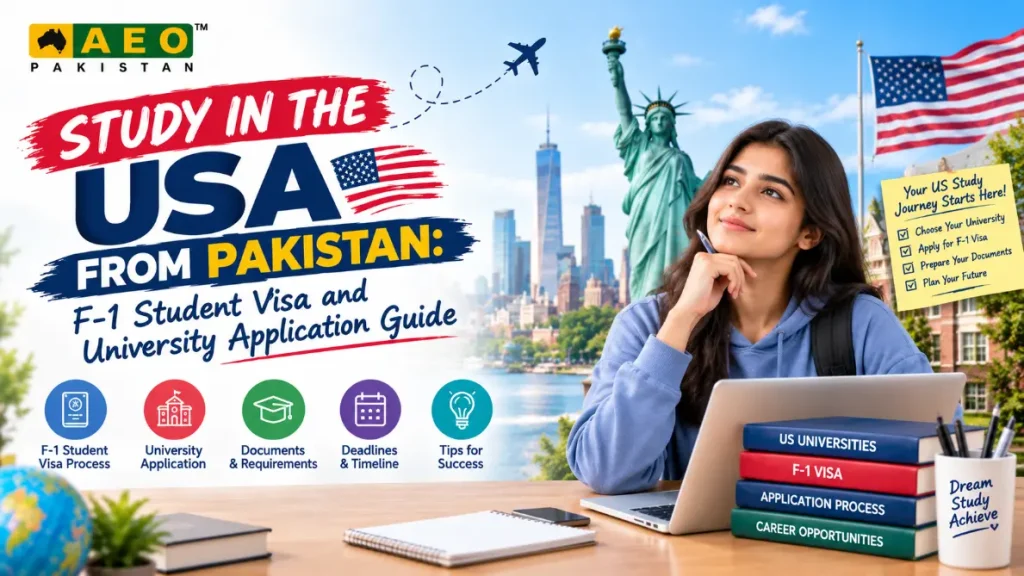
Study in the USA from Pakistan: F-1 Student Visa and University Application Guide
Studying in the United States offers Pakistani students an exciting opportunity to earn internationally recognized qualifications, explore diverse academic programs, and gain exposure to research and innovation. From undergraduate degrees to master’s and doctoral programs, American universities offer a wide range of options across business, engineering, computer science, healthcare, social sciences, and other fields.
However, planning to study in the USA from Pakistan involves more than choosing a university. Students need to research suitable programs, meet admission requirements, prepare academic documents, demonstrate financial readiness, and apply for the appropriate student visa.
For most international students pursuing full-time academic studies at a US college or university, the relevant visa category is the F-1 student visa. The process generally begins with admission to a Student and Exchange Visitor Program (SEVP)- certified school, followed by receiving Form I-20, paying the required SEVIS fee, and completing the visa application process.
This guide explains the main steps Pakistani students should follow when applying to US universities and preparing for an F-1 student visa.
Why Study in the USA from Pakistan?
The United States offers a wide variety of higher education institutions, including public universities, private universities, liberal arts colleges, and community colleges. Students can explore different academic pathways depending on their qualifications, interests, and budget.
Some key reasons Pakistani students consider US universities include:
- Wide course selection: Programs are available in business, computer science, engineering, healthcare, finance, arts, and many other fields.
- Research opportunities: Eligible students may access research facilities, laboratories, and academic projects.
- Flexible academic pathways: Some institutions offer options to explore subjects before selecting a major, depending on the program.
- Scholarships and financial aid: Universities may offer merit-based scholarships, need-based assistance, or funding for eligible students.
- Career development: Internships and practical learning opportunities may be available depending on the course and institution.
Before choosing a university, compare tuition fees, living expenses, course content, location, admission requirements, and the financial support available to international students.
How to Choose the Right US University
Choosing the right institution is one of the most important steps when planning to study in America from Pakistan. A highly reputable university may not be the best match for your academic background or financial situation.
Check university accreditation and SEVP certification.
Confirm that the institution is appropriately accredited for your intended program and is certified by the Student and Exchange Visitor Program (SEVP) to enroll international students in the relevant visa category.
SEVP certification is essential for schools enrolling F-1 students. You can check eligible institutions through the official Study in the States school search.
Compare programs and admission requirements.
Review the entry requirements for each course before applying. Depending on the degree and institution, you may need:
- Previous academic certificates and transcripts
- SAT or ACT scores, if required
- GRE or GMAT scores, if required
- IELTS, TOEFL, or another accepted English proficiency test
- Letters of recommendation
- A statement of purpose or personal essay
- A CV or portfolio for relevant programs
Requirements vary by institution and course. Do not assume that every US university requires the same tests or documents.
Evaluate tuition fees and living costs.
Calculate the total estimated cost of attendance, including tuition, accommodation, food, health insurance, transportation, books, and personal expenses. A university with lower tuition may still be expensive if it’s in a high-cost city.
Compare the total annual budget and any scholarships before deciding where to apply.
How to Apply to US Universities from Pakistan
The US university application process varies by institution, but these steps provide a useful starting point.
Research courses and universities
Shortlist institutions based on your academic record, career goals, location preferences, and budget. Check the admission requirements and application deadlines for each program.
Prepare academic documents
Gather your certificates, transcripts, passport details, English test results, and other required documents. Arrange certified translations if requested by the institution.
Complete the university application
Fill in the application form accurately, submit your personal statement and references where required, and pay the applicable application fee.
Review your admission offer
If accepted, read the offer conditions, tuition information, deposit requirements, and scholarship terms. Ask the university about any outstanding requirements.
Obtain Form I-20
Once the required conditions are met and the school completes its international student procedures, it can issue Form I-20 for eligible students.
Start early because application deadlines, document requirements, and processing times differ between institutions. EducationUSA recommends a structured approach that covers researching universities, financing studies, completing applications, applying for a visa, and preparing for departure.
What Is the F-1 Student Visa?
The F-1 visa is a nonimmigrant visa for eligible international students pursuing academic studies at an eligible US institution. It is commonly used by international students attending universities, colleges, and other qualifying academic institutions.
Students generally need admission from an SEVP-certified school before they can begin the F-1 visa process. The school uses the Student and Exchange Visitor Information System (SEVIS) to register eligible students and issue Form I-20.
What is Form I-20?
Form I-20, also called the Certificate of Eligibility for Nonimmigrant Student Status, is issued by an eligible school to an admitted student who meets its requirements for the relevant student status.
It contains important information about your program and student record, including your SEVIS identification number. You will need this information when completing your visa application.
Review the form carefully and contact your school’s designated school official if any details need correction.
What is SEVIS?
SEVIS is the US government system used to maintain records on international students and exchange visitors. Students applying for an F-1 visa generally need to pay the applicable SEVIS I-901 fee unless an exemption applies.
Check the official SEVIS I-901 fee information for the current amount, payment instructions, and any applicable exemptions. Do not confuse the SEVIS fee with the visa application fee; they are separate charges.
F-1 Student Visa Requirements for Pakistani Students
Once you have received Form I-20, you can prepare your student visa application. The exact procedure and appointment instructions should be checked through the official US visa application resources for Pakistan.
The main steps generally include:
Step 1: Complete the DS-160 form
Complete the Online Nonimmigrant Visa Application, Form DS-160, and answer all questions truthfully. You will need information such as your passport details, education history, travel information, and school details.
After submitting the form, save and print the confirmation page for your interview. Check every answer carefully because incorrect or incomplete information can lead to corrections or delays.
Step 2: Pay the applicable fees
The visa application fee and SEVIS fee are separate payments. Confirm the latest fees, accepted payment methods, and instructions before paying.
As the fees and procedures may change, use the official US Department of State student visa page and the relevant US visa application portal for Pakistan.
Step 3: Schedule your visa interview
Follow the appointment instructions applicable to applicants in Pakistan. Interview availability varies, so plan and monitor the official appointment system.
An interview is generally required for student visa applicants, although limited exceptions may apply. A consular officer can request additional information or documentation.
Step 4: Prepare your documents
Use the official requirements as your primary checklist. Depending on your circumstances, you may need:
- Valid passport
- DS-160 confirmation page
- Form I-20 signed as required
- Visa application fee receipt, where applicable
- Photograph meeting the official specifications
- SEVIS fee payment confirmation, where applicable
- Academic certificates and transcripts
- Required standardized test results
- Financial evidence showing how you will pay educational and living expenses
- Documents supporting your study plans
The consular officer may ask for additional evidence of your academic preparation, financial resources, and intention to depart the United States after your authorized period of study.
How to Prepare for the F-1 Visa Interview
The F-1 visa interview is an important part of the application process. Your answers should be clear, truthful, and consistent with your university application and supporting documents.
Prepare to explain:
- Why you selected your course and university
- How the program connects with your previous education
- How you plan to finance tuition and living expenses
- What you understand about the program
- Your plans after completing your studies
For example, if asked why you chose a particular university, explain the specific academic features that make it suitable for you rather than relying only on its reputation.
Avoid memorizing scripted answers or presenting inaccurate information. EducationUSA advises students to be prepared to explain their study motivation, financial arrangements and plans after completing their studies.
Important: No consultant, university, or preparation service can guarantee F-1 visa approval. The consular officer decides based on applicable law and your individual circumstances.
How Much Does It Cost to Study in the USA from Pakistan?
The cost of studying in the United States varies significantly by institution, program and location. Your budget should include more than tuition fees.
Expense category | What to consider |
|---|---|
Tuition | Annual program fees and any required deposits |
Accommodation | University housing or private rent |
Food and groceries | Meal plans and everyday expenses |
Health insurance | Institution or state requirements |
University fees | Student services, facilities and other charges |
Visa expenses | Visa application and SEVIS fees |
Travel | Flights, local transport and airport transfers |
Study materials | Books, software and equipment |
Emergency funds | Unexpected costs and initial settling-in expenses |
Request an official cost-of-attendance estimate from each university. Then compare it with your available funding, including savings, family support, scholarships and any confirmed financial assistance.
Do not rely on part-time employment as your main funding plan. F-1 students face specific employment restrictions, and any work must comply with the applicable rules.
Scholarships for Pakistani Students in the USA
Scholarships can reduce the financial burden of studying abroad, but eligibility and funding vary by institution and program.
Explore these possibilities:
- Merit-based scholarships: May be awarded based on academic performance or other achievements.
- Need-based financial aid: Available at some institutions to eligible students who demonstrate financial need.
- Graduate assistantships: Certain graduate programs offer teaching or research positions with funding, depending on eligibility and availability.
- Departmental awards: Some academic departments provide funding for students in specific disciplines.
- External funding: Organizations may offer scholarships or educational support to eligible applicants.
Check whether each award is available to international students, whether a separate application is required, and whether the scholarship covers tuition, living expenses, or both.
Apply before the deadline and never assume a scholarship is guaranteed just because you meet the minimum admission criteria.
Common Mistakes to Avoid When Applying for a US Student Visa
Pakistani students can make the process more manageable by avoiding these common errors:
- Applying to unsuitable universities: Check entry requirements and course relevance before applying.
- Missing deadlines: Track admission, scholarship, and visa appointment dates separately.
- Submitting incomplete documents: Use a checklist for each institution and the visa process.
- Providing inconsistent information: Ensure that your forms and supporting documents match.
- Underestimating the total cost: Budget for tuition, accommodation, insurance, and other expenses.
- Relying on outdated information: Check current fees and procedures through official sources.
- Making false statements: Never submit fabricated documents or misleading information.
- Buying flights too early: Wait until your visa has been issued before making final travel arrangements.
A student visa is not guaranteed, and a visa itself does not automatically guarantee entry into the United States. US border officials make the final admission decision at the port of entry.
How AEO Pakistan Can Support Your Study Abroad Planning
Preparing university applications and understanding the student visa process can feel complicated, especially when managing multiple deadlines and document requirements.
AEO Pakistan is a study-abroad consultancy website Pakistani students can explore for guidance on their international education plans. Students considering the United States should confirm the scope of any counseling service, the institutions it supports, and the specific services available before engaging a provider.
Useful support may include university shortlisting, application preparation, document checks and guidance on understanding official visa instructions. Students remain responsible for providing accurate information and meeting university and government requirements.
For reliable visa information, always refer to the US Department of State and EducationUSA’s US study guide.
Conclusion
Planning to study in the USA from Pakistan requires careful university selection, early application preparation, financial planning, and a clear understanding of the F-1 student visa process.
Start by identifying suitable programs and checking their entry requirements. Once admitted to an eligible institution, review Form I-20, SEVIS requirements, the DS-160 application, and the latest interview instructions. Prepare accurate documents, understand your finances, and answer visa questions honestly.
By planning and using official sources for current requirements, Pakistani students can approach the US university application and student visa process with greater confidence.
FAQ's About Study in the USA from Pakistan
How can I study in the USA from Pakistan?
Research suitable universities, meet their admission requirements, submit your application, and obtain admission to an SEVP-certified school. After receiving Form I-20, complete the required SEVIS and visa application steps and follow the official interview instructions.
What is the F-1 student visa for the USA?
The F-1 visa is for eligible international students pursuing academic studies at qualifying US institutions. Students generally need admission to an SEVP-certified school and Form I-20 before applying for the visa.
What documents are required for an F-1 student visa from Pakistan?
Common documents include a valid passport, DS-160 confirmation page, Form I-20, photograph, and fee receipts where applicable. You may also need academic records, test results, and financial evidence. Always check the current official instructions for your application.
How much bank balance is required for a US student visa?
No single universal bank-balance figure applies to every student. You should be prepared to demonstrate that you can cover the educational, living, and travel expenses relevant to your circumstances. Follow the school’s financial documentation requirements and official visa instructions.
Can Pakistani students get scholarships to study in the USA?
Yes, some US institutions offer scholarships or other financial assistance to eligible international students. Availability depends on the university, degree, academic record, and funding conditions. Check the official scholarship rules and deadlines before applying.
Can F-1 students work while studying in the USA?
F-1 students may qualify for certain types of employment, but strict rules apply. On-campus employment and authorized training opportunities may be possible in eligible circumstances. Students should confirm the rules with their designated school official and the relevant US government guidance before accepting work.
