

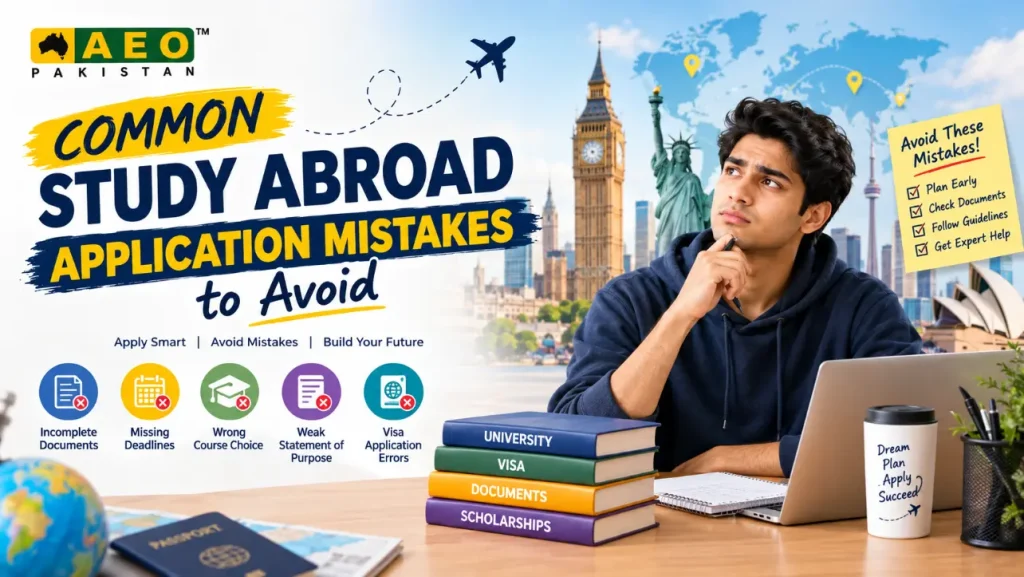
Common Study Abroad Application Mistakes to Avoid
Studying abroad is a major academic and career decision. For Pakistani students, the journey can involve choosing the right country and university, meeting admission requirements, preparing academic documents, taking an English language test, submitting applications, arranging finances, and preparing for a student visa.
A single avoidable mistake can create unnecessary delays or make an application less competitive. The good news is that proper planning and attention to detail can prevent most study abroad application mistakes.
AEO Pakistan provides counseling, university application support, visa guidance, IELTS testing and preparation, and study-abroad services for destinations including Australia, the UK, USA, Malaysia, Dubai/UAE, Canada, and New Zealand.
If you are planning to study abroad, here are the most common mistakes you should avoid.
1. Choosing a University Without Researching the Course
One of the biggest university application mistakes is choosing a university simply because it is famous or because someone else recommends it.
A university may have an excellent reputation but still not offer the right course structure, specialization, location, tuition level, or career opportunities for you.
Before applying, research:
- Course modules and subjects
- Entry requirements
- Tuition fees
- Course duration
- University location
- Available scholarships
- Internship or industry opportunities
- Graduate career prospects
- English language requirements
- Intakes and application deadlines
Your choice should be based on your academic background, career goals, budget, and personal preferences.
For example, AEO Pakistan highlights different benefits across its study destinations. Australia is promoted for education, innovation, and career development, while Malaysia is highlighted for quality education at comparatively affordable costs.
How to avoid this mistake
Create a shortlist of universities and compare them before submitting applications. Don’t apply simply because a university appears in a ranking or because a friend is studying there.
2. Applying for the Wrong Course
Another common study abroad application mistake is choosing a course that doesn’t logically connect with your previous education or future career plans.
Universities may assess whether your academic background is suitable for the program. Your application should therefore demonstrate a clear academic progression.
For example, if you have a bachelor’s degree in computer science, applying for a completely unrelated postgraduate program without explaining the change could raise questions.
Before selecting a course, ask:
Does this program match my previous education?
Will it help me achieve my career goals?
Do I meet the academic requirements?
Can I explain why I want to study this subject?
A well-researched course choice makes your overall application more coherent.
3. Missing University Application Deadlines
Missing an application deadline for international students can limit your options and potentially force you to wait for another intake.
Many students underestimate how long the application process takes. You may need additional time for:
- IELTS preparation and testing
- Obtaining transcripts
- Attested or certified documents
- Writing a personal statement or SOP
- Obtaining references
- Scholarship applications
- University processing
- Receiving an offer
- Visa preparation
Some application systems also have course-specific deadlines. UCAS, for example, advises applicants to check the deadline applicable to their course and submit applications with enough time for the relevant checks and processing.
How to avoid this mistake
Create a study abroad application timeline at least several months before your intended intake. Record separate deadlines for:
- University application
- Scholarship application
- English language test
- Offer acceptance
- Tuition deposit
- Student visa
- Accommodation
Don’t wait until the last week.
4. Submitting Incomplete or Incorrect Documents
Incomplete documentation is one of the most preventable student visa and university application mistakes.
Depending on the university and destination, students may need documents such as:
- Valid passport
- Academic certificates
- Academic transcripts
- English language test results
- Personal statement or SOP
- CV
- Recommendation letters
- Financial documents
- Portfolio, where applicable
- Employment documents, where applicable
Even small errors can cause problems. Make sure your name, date of birth, academic dates, grades, passport details, and other personal information match across all documents.
For example, current UK Student visa guidance requires a valid passport and CAS. At the same time, additional documents such as financial evidence, ATAS certification, TB test results, or sponsorship evidence may apply depending on the student’s circumstances.
How to avoid this mistake
Prepare a document checklist specific to your university and destination. Check every document before uploading or submitting it.
5. Ignoring English Language Requirements
Many students assume that studying in English automatically means they don’t need an English language test.
This is not always the case.
Universities and visa authorities can have different requirements depending on the country, university, course, and applicant’s circumstances.
IELTS is one of the most widely used English language tests internationally. AEO Pakistan provides IELTS testing and preparation services, including Academic, General, UKVI, Life Skills, and computer-delivered IELTS options.
How to avoid this mistake
Check the exact English language requirement for your chosen course before applying.
Pay attention to:
- Overall IELTS score
- Individual band requirements
- Accepted English tests
- Test validity
- Course-specific requirements
- Visa-specific requirements
If you need to improve your score, schedule your IELTS preparation and test date early enough to meet your university deadline.
6. Writing a Generic Statement of Purpose
A weak or generic Statement of Purpose (SOP) is another common mistake.
Your SOP should explain why you want to study the selected course, how your previous education or experience prepared you for it, and how the program fits into your plans.
Avoid simply writing:
“This university is one of the best universities in the world.”
Instead, explain why the particular course is suitable for you.
A strong application should show genuine interest in and knowledge of the chosen subject. UCAS guidance for international applicants similarly emphasizes explaining why you want to study the subject, how your qualifications have prepared you, and how relevant experiences support your application.
How to avoid this mistake
Before writing your SOP, research:
- Your course
- Relevant modules
- University strengths
- Your academic background
- Your career objectives
- Relevant projects or experience
Then connect these elements naturally.
7. Copying an SOP or Using the Same Statement Everywhere
Using the same statement for every university can make your application appear generic.
Each university and course may have different strengths and requirements. Your application should reflect your actual academic goals rather than relying on a template.
Also, avoid copying content from another student’s SOP or online samples.
UCAS specifically advises that a personal statement should sound like it was written by the applicant and warns that similarity-checking processes can identify copied or templated material.
Better approach
Use your own experiences, achievements, interests, academic journey, and career plans. Professional guidance can help you structure your application, but the information should genuinely represent you.
8. Not Planning Your Study Abroad Budget
Tuition fees are only one part of the total cost of studying abroad.
Students should consider:
- Tuition fees
- Accommodation
- Food
- Transportation
- Health insurance
- Visa fees
- English language testing
- Travel expenses
- Study materials
- Emergency funds
Financial planning is especially important during the student visa process.
For example, UK Student visa applicants may need to demonstrate funds for course fees and living costs, with specific evidence requirements depending on their circumstances. Current UK guidance also specifies how long certain funds must be held before applying.
How to avoid this mistake
Prepare a realistic budget before accepting an offer. Don’t calculate your budget using tuition fees alone.
Also research scholarships for international students and other funding options before finalizing your university choice.
9. Waiting Too Long to Start the Visa Process
Receiving a university offer is exciting, but it does not mean the entire study abroad process is complete.
After receiving an offer, you may still need to:
- Accept the offer
- Pay a required deposit
- Obtain required university documents
- Prepare financial evidence
- Complete visa forms
- Book biometrics
- Complete health or TB requirements where applicable
- Prepare supporting documents
Visa requirements differ by destination, so students should always follow the current official requirements for their chosen country.
AEO Pakistan states that its study-abroad processing service includes assistance from application submission through visa preparation.
How to avoid this mistake
Start preparing visa documentation as soon as you receive your university offer. Don’t wait until your course start date is approaching.
10. Providing Inconsistent Information
One of the most important student visa application tips is to keep your information accurate and consistent.
Check that the following details match wherever applicable:
- Full name
- Date of birth
- Passport number
- Education history
- Employment history
- Course details
- Travel history
- Financial information
Inconsistent information can create unnecessary questions or delays.
Before submitting your application, compare your online form against your passport and supporting documents.
11. Applying Without Checking the Latest Requirements
Study abroad requirements can change.
Universities or government authorities may update entry requirements, tuition fees, scholarship conditions, English language requirements, visa rules, financial requirements, and application procedures.
Therefore, avoid relying entirely on:
- Old YouTube videos
- Outdated blog posts
- Friends’ previous experiences
- Social media comments
- Old application checklists
Always verify important requirements through the relevant university and official government sources.
This is particularly important for visa applications because requirements can change over time. For example, the UK government updated its Student visa financial requirements in December 2025.
12. Trying to Manage Everything at the Last Minute
Perhaps the biggest mistake is treating the entire process as a quick application.
Studying abroad requires planning.
A better approach is to break the journey into stages:
StageWhat to Do
- Research Compare countries, universities and courses
- Planning Check eligibility, budget and intake
- Preparation Prepare IELTS and academic documents
- Application Submit accurate university applications
- Offer Review and accept your offer
- Visa Prepare financial and visa documents
- Pre-departure Arrange accommodation, travel and essentials
This approach makes the study abroad application process much more manageable.
How AEO Pakistan Can Help Students Avoid Application Mistakes
Choosing the right guidance can make the process easier for students who are unfamiliar with international university admissions.
AEO Pakistan offers counseling and processing support, helping students identify suitable programs and universities, submit applications, meet visa requirements, and access IELTS testing and preparation services.
AEO Pakistan also supports students interested in destinations including Australia, Canada, USA, the UK, New Zealand, Malaysia, and the UAE, giving students access to different study-abroad pathways.
Professional guidance does not replace the student’s responsibility to provide truthful and accurate information, but it can help students understand requirements and organize the application process more effectively.
Final Checklist: Avoid These Study Abroad Application Mistakes
Before submitting your application, ask yourself:
- Have I selected the right course for my academic background?
- Have I researched the university properly?
- Do I meet all admission requirements?
- Have I checked the application deadline?
- Is my passport valid?
- Are all academic documents accurate?
- Have I checked the required IELTS or English language score?
- Is my SOP original and relevant to my course?
- Have I planned my tuition and living expenses?
- Have I researched available scholarships?
- Have I checked the latest student visa requirements?
- Is all information consistent across my documents?
If you can answer yes to these questions, you are in a much stronger position to submit a well-prepared application.
Conclusion
Avoiding common study abroad application mistakes starts with careful research, early preparation, accurate documentation, and a clear understanding of your academic and financial goals. Whether you plan to study in Australia, the UK, USA, Canada, Malaysia, New Zealand, or the UAE, taking time to prepare your application properly can make the overall journey smoother.
For Pakistani students, professional study-abroad counseling can also help when comparing universities, preparing applications, and understanding visa requirements. With the right planning and attention to detail, you can avoid preventable errors and move confidently toward your international education goals.
FAQ's
What are the most common study abroad application mistakes?
Common mistakes include choosing the wrong course, missing deadlines, submitting incomplete documents, ignoring English language requirements, writing a generic SOP, providing inconsistent information, and failing to plan finances and visa documentation.
How can I avoid mistakes in my university application?
Research your course and university carefully, create a document checklist, verify admission requirements, track deadlines, proofread your application, and make sure all information is accurate and consistent.
Is IELTS required for every study abroad application?
Not necessarily. English language requirements vary by country, university, course, and applicant. Always check the exact requirements for your chosen institution before booking a test.
What documents are usually required to study abroad?
Requirements vary, but students may need a passport, academic certificates and transcripts, English language test results, SOP or personal statement, references, CV, financial documents, and other course- or visa-specific documents.
When should I start my study abroad application?
Ideally, start several months before your intended intake. Early preparation gives you time to research universities, take IELTS, prepare documents, apply for scholarships, receive an offer, and complete visa preparations.
Can a study abroad consultant help avoid application mistakes?
Yes. An experienced consultant can help students understand university requirements, shortlist suitable courses, organize application documents, submit applications, and prepare for the visa process. AEO Pakistan specifically offers counseling, processing, visa guidance, and IELTS-related services for students planning to study abroad.
